
Quick answer
What is a VRF system?
A VRF (Variable Refrigerant Flow) system is a central air conditioning system in which one outdoor unit, or a group of outdoor modules, is connected by refrigerant piping to many indoor units. Inverter-driven compressors and electronic expansion valves vary the amount of refrigerant sent to each indoor unit, so every room or zone gets exactly the cooling it needs and can be controlled on its own.
Key takeaways
- VRF stands for Variable Refrigerant Flow. VRV (Variable Refrigerant Volume) is Daikin's trade name for the same technology.
- One outdoor system can serve dozens of indoor units, each with its own temperature control.
- Inverter compressors run at part load most of the time, which is where VRF saves energy compared with fixed-speed systems.
- VRF suits offices, hotels, residential towers, villas, retail, schools and clinics. Large open spaces and very large loads are usually better served by package units or chilled water.
- VRF does not supply fresh air on its own. It needs a fresh air handling unit (FAHU) or energy recovery unit alongside it.
VRF full form in HVAC
In HVAC, VRF means Variable Refrigerant Flow. The name describes what the system does: instead of switching a compressor fully on and off, it continuously changes the flow of refrigerant to match the load in each zone. The technology was first introduced in Japan in the early 1980s and is now one of the most common air conditioning systems in commercial and high-end residential buildings across the UAE.
How does a VRF system work?
A VRF system is a direct-expansion (DX) system: refrigerant itself carries heat between the rooms and the outdoor unit, with no chilled water in between. The cycle works like this:
- Sensing the load. Each indoor unit reads its room temperature and set point and reports its demand to the outdoor unit over control wiring.
- Varying compressor speed. Inverter compressors in the outdoor unit speed up or slow down to match the combined demand of all indoor units, instead of cycling on and off.
- Metering refrigerant. An electronic expansion valve (EEV) in each indoor unit opens or closes to let in exactly the refrigerant that zone needs.
- Absorbing heat. Liquid refrigerant evaporates in the indoor coil, absorbing heat from the room air, and returns as gas to the outdoor unit.
- Rejecting heat. The outdoor unit compresses the gas and rejects the heat to outside air through its condenser coil, and the cycle repeats.
Because most buildings run below their peak cooling load for most of the day, the system spends most of its time at part load. That is where inverter-driven VRF uses noticeably less energy than fixed-speed equipment.
Main components of a VRF system
| Component | What it does |
|---|---|
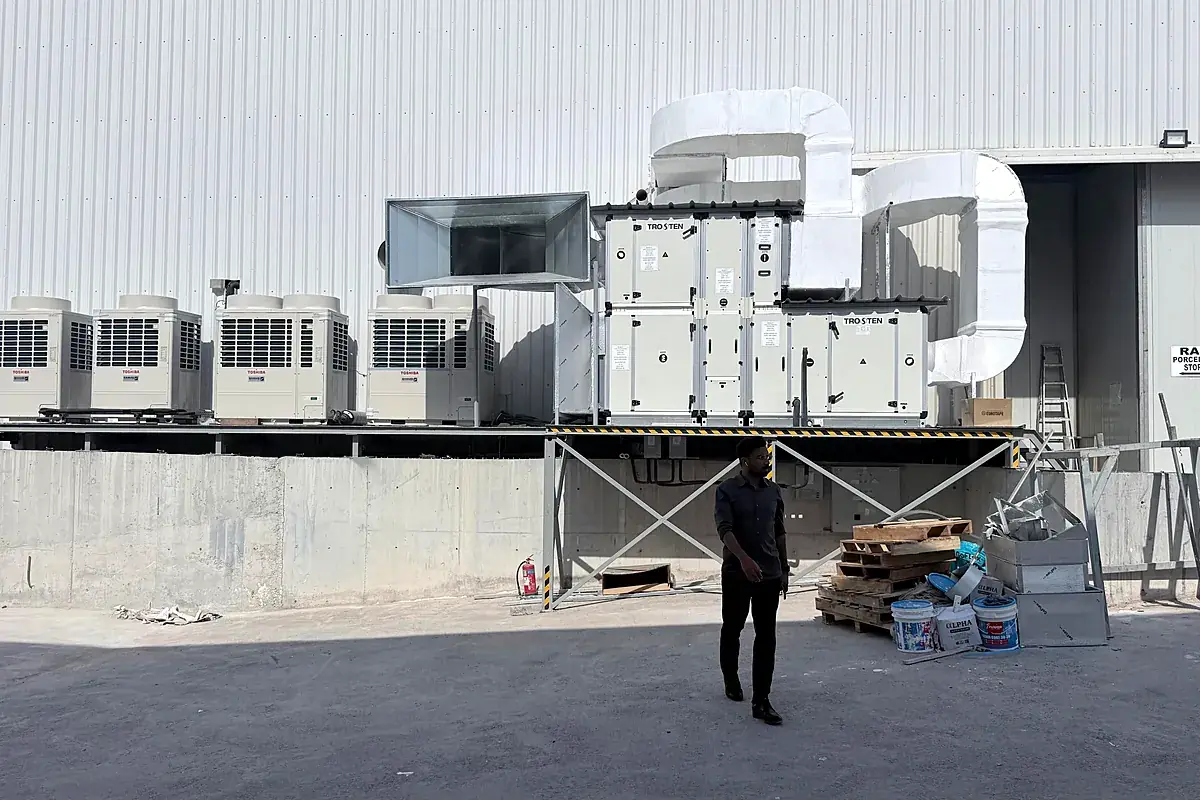
| Outdoor unit (condensing unit) | Houses the inverter compressors, condenser coil and fans. Single modules can be combined for higher capacity. |
| Indoor units | Wall-mounted, ceiling cassette, ducted (low or high static), floor-standing or ceiling-suspended units, chosen per room. |
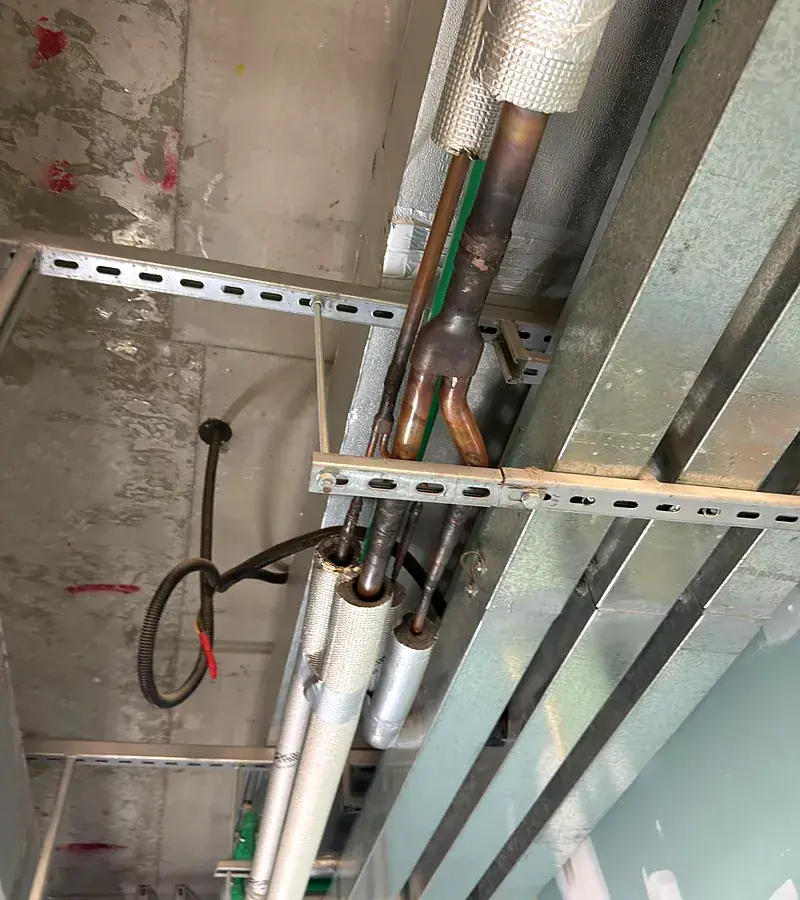
| Refrigerant piping | Insulated copper liquid and gas lines that connect the outdoor unit to every indoor unit. |
| Branch joints / headers | Manufacturer-specified fittings (often called refnets) that split refrigerant flow to each indoor unit. |
| Branch / mode selector boxes | Used in heat recovery systems to let individual zones cool or heat at the same time. |
| Controls | Individual room controllers, central controllers and BMS integration for scheduling, monitoring and fault reporting. |
Types of VRF systems: heat pump vs heat recovery
Heat pump VRF
All indoor units on one system run in the same mode, either cooling or heating. This is the most common type in the UAE, where buildings need cooling for most of the year.
Heat recovery VRF
Different zones can cool and heat at the same time. Heat removed from one zone is reused in another. It is used where loads vary a lot between zones, such as some hotels, hospitals and mixed-use buildings.
VRF vs VRV: is there a difference?
No, not in how they work. VRV stands for Variable Refrigerant Volume and is a trademark of Daikin, the company that introduced the technology. Other manufacturers cannot use the VRV name, so they call the same type of system VRF. Toshiba, LG, Mitsubishi Electric, Carrier, Trane, Hisense and other brands all make VRF systems.
When a tender or drawing says "VRV system", it almost always means a variable refrigerant system in general. Unless the specification names a single brand, compliant VRF equipment from other manufacturers can usually be proposed as an alternative, subject to consultant approval.
VRF vs split, ducted split and chiller systems
| VRF | Split / ducted split | Chilled water (chiller) | |
|---|---|---|---|
| Best suited to | Multi-zone buildings, mid to large | Single rooms, small offices, villas | Very large buildings and campuses |
| Zone control | Individual control for every room | One unit per room or area | Per FCU or AHU, via controls |
| Part-load efficiency | High (inverter, variable flow) | Good with inverter units | High at large scale |
| Outdoor space | Compact, few outdoor units | Many outdoor units on facades or roofs | Plant room, chillers, pumps, cooling towers |
| Installation | Refrigerant piping, brazing and pressure testing | Simple, fast | Chilled water piping, pumps, valves |
| Fresh air | Needs separate FAHU / ERV | Needs separate fresh air | Usually through AHUs |
| Expansion | Add indoor units within system capacity | Add more units | Designed in at plant stage |
For a detailed comparison with chilled water systems, read our guide on VRF vs chiller systems for UAE buildings.
When should you use a VRF system?
VRF is a strong fit for
- Offices and commercial buildings with many tenants or rooms
- Hotels and serviced apartments, where each room needs its own control
- Residential towers and staff accommodation
- Large villas, replacing many separate split units
- Schools, clinics and retail units
- Retrofits, where there is no space for a chiller plant
Consider other systems for
- Warehouses and factories with large open floor areas (package or rooftop units)
- Very large malls and campuses (chilled water)
- Buildings connected to district cooling
- Spaces with very high fresh air demand, such as kitchens and labs

VRF design points for the UAE climate
- High ambient rating. Summer outdoor temperatures in the UAE regularly pass 45°C. Outdoor units must be selected for high-ambient (T3) conditions, and capacity must be checked at the design ambient, not the catalogue rating.
- Outdoor unit placement. Units need enough clearance to avoid hot air recirculating back into the coil, a common cause of high-pressure trips on crowded rooftops.
- Pipe length and height limits. Every manufacturer sets limits for total pipe length, distance to the furthest unit and height difference between units. These decide how many systems a tower needs and where the outdoor units can go.
- Diversity and connection ratio. Indoor unit capacity can usually exceed outdoor capacity within the manufacturer's limit, because not every zone peaks at once. It must be checked against real occupancy patterns.
- Refrigerant concentration. In small rooms, the total refrigerant charge of a system must be checked against safety limits in standards such as ISO 5149, which may call for smaller systems or leak detection.
- Fresh air and humidity. Treated fresh air from a FAHU or energy recovery unit is needed to meet ventilation requirements and control humidity, especially in coastal areas.
- Dust and sand. Coil protection and easy access for cleaning matter in the UAE, where dust quickly reduces outdoor coil performance.
- Authority and green building rules. Designs must meet the requirements of the local authority, such as Dubai Municipality and the Dubai Green Building Regulations, as well as the project consultant's specification.
Planning a VRF project?
IEC UAE supplies, installs, commissions and maintains multi-brand VRF systems, and takes VRF subcontract packages from main contractors.
VRF installation and commissioning
A VRF system is only as reliable as its refrigerant piping. Most long-term faults trace back to installation, so these steps matter:
- Piping design. Pipe sizes, branch joint positions and the extra refrigerant charge are calculated with the manufacturer's selection software.
- Brazing with nitrogen. Joints are brazed while dry nitrogen flows through the pipe, to stop oxide scale forming inside and blocking valves later.
- Pressure testing. The complete pipe network is pressure tested with nitrogen at the manufacturer's test pressure and held to prove there are no leaks.
- Vacuum and dehydration. The system is evacuated to a deep vacuum to remove moisture and air before refrigerant is released.
- Refrigerant charging. Additional refrigerant is weighed in based on actual installed pipe lengths and recorded on the unit.
- Commissioning. Addressing, test runs, operating pressure and temperature checks, and controls setup are done, then recorded in commissioning reports for handover.
VRF maintenance
A well-installed VRF system can run reliably for many years if it is maintained on a fixed schedule. In UAE conditions, quarterly preventive maintenance is a sensible minimum for commercial buildings, with extra checks before summer. A typical visit covers:
- Cleaning indoor unit filters, coils and condensate drains
- Cleaning outdoor condenser coils and checking fans
- Checking operating pressures, temperatures and compressor current
- Reviewing the controller's error and alarm history
- Inspecting pipe insulation and checking for refrigerant leaks
- Testing controls, schedules and BMS communication
IEC UAE provides VRF and HVAC maintenance contracts in Dubai and across the UAE, with service reports after every visit.
Summary
A VRF system uses inverter compressors and variable refrigerant flow to give individual, efficient cooling to many zones from one outdoor system. VRF and VRV are the same technology under different names. It is the right choice for most multi-zone buildings in the UAE, provided it is selected for high ambient conditions, paired with a fresh air system and installed with careful piping practice.